
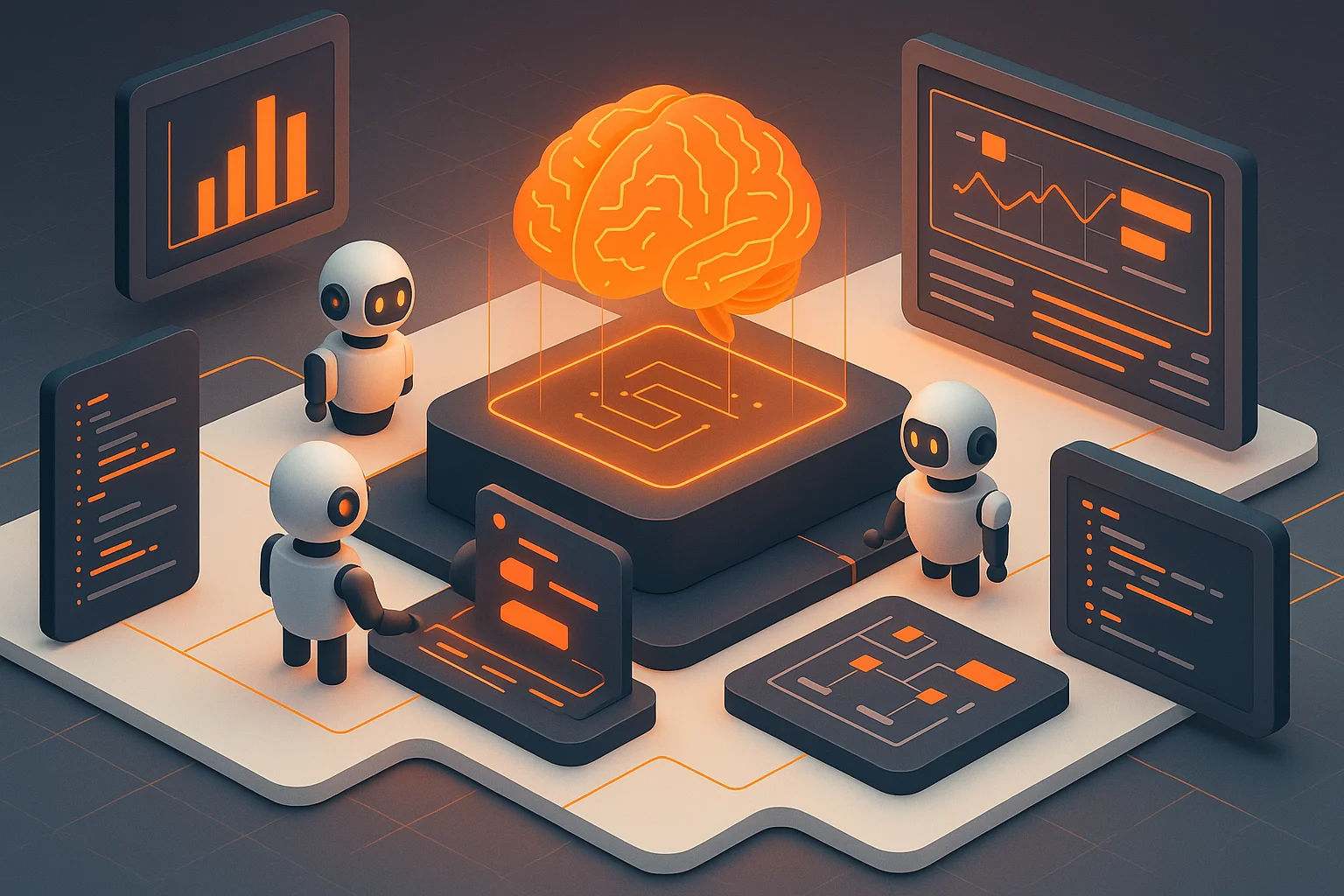
AI coding agents have moved from a speculative idea to a practical force reshaping how software is designed, written and maintained. An AI coding agent is not simply a faster autocomplete; it is an autonomous collaborator that can interpret a goal, plan a sequence of tasks, write or modify code, run tests and iterate on results until the objective is met. This change alters both the day-to-day workflow of engineers and the higher-level organisation of engineering teams, so understanding the role of an AI coding agent is essential for any group aiming to deliver software faster without sacrificing quality.
At a technical level, the value of an AI coding agent is rooted in its ability to combine natural language understanding, code generation and tool use. Where previous tools offered line-by-line suggestions, a modern AI coding agent can parse an issue description, map that description to files and functions in a repository, and propose a multi-step plan that includes writing new modules, updating interfaces and creating tests. The agent then executes parts of that plan in a sandbox or continuous integration environment, observes failures, amends its approach and re-runs checks until it achieves acceptable results. This closed loop of plan, act, observe and correct is what transforms a helper into an agent capable of delivering complete increments of work.
The adoption of AI coding agents changes the balance of labour in engineering teams. Routine, well-scoped tasks such as implementing a standard API, refactoring repetitive code or creating canonical tests are often faster when an AI coding agent handles the bulk of the work; humans then focus on design decisions, complex edge cases and system architecture. As a consequence, junior engineers can be more productive earlier in their careers because the AI coding agent helps with scaffolding and boilerplate, while senior engineers invest time in higher-leverage activities. This redistribution improves throughput without simply shifting the same burden to oversight work, provided teams develop robust review processes.
Integration and safety are central to the responsible role of an AI coding agent. Because agents can change many files and run code, engineering teams must establish guardrails — such as explicit permission levels, thorough test coverage and reproducible sandboxes — so that agent-driven changes are observable and reversible. An AI coding agent must be treated as a member of the development process: it should produce human-readable rationales for its decisions, attach tests to the changes it proposes and reference the files it modifies. When these practices are in place, the agent becomes auditable and traceable, which is vital for security, compliance and knowledge transfer.
The ways in which AI coding agents are evaluated also influence how teams use them. Traditional metrics like lines of code or velocity do not capture the quality of changes or the cognitive relief provided. Instead, teams measure reduction in cycle time for specific ticket types, number of regressions introduced, and the ratio of agent-created changes accepted without modification. An effective AI coding agent will reduce repetitive churn, enable faster delivery of feature-complete increments and lower the incidence of trivial defects. Over time, organisations that fine-tune agents on their own codebases and tests tend to see more consistent results because the agent learns project-specific patterns and conventions.
AI coding agents are particularly useful in long-lived codebases with established patterns and extensive test suites. In these contexts, the agent can rely on historical examples to produce idiomatic changes and use the test suite as an immediate safety net. Conversely, in greenfield projects or in highly experimental modules, the role of an AI coding agent is more limited: it can accelerate prototyping but human designers must lead on architecture and novel algorithmic work. Thus the role of the agent is contextual rather than universal; it thrives where constraints and expectations are well defined, and it assists humans where creativity and strategic judgment are necessary.
The human–agent collaboration model is evolving as teams experiment with dividing work across roles. Some organisations use an AI coding agent as a persistent pair programmer, giving it access to the current branch and asking for incremental changes during a live coding session. Others employ agents as batch workers: assign a set of issues, let the agent work in isolation, and later review the aggregated changes. Each approach requires different governance: a live pair needs immediate feedback and interruption mechanisms, while batch operation needs rigorous change review and a rollback plan. Both models show that the role of the agent is flexible, adapting to the team’s preferred cadence and risk tolerance.
Another critical dimension of the role of AI coding agents is the effect on developer learning and skill development. When an AI coding agent provides code patterns, test examples and refactoring suggestions, it can accelerate learning by exposing less experienced engineers to idiomatic solutions and standard practices. However, there is a risk that overreliance on an AI coding agent may blunt deeper comprehension if developers accept changes without understanding them. The optimal role of the agent is therefore pedagogical as well as operational: it should explain its choices and present alternatives so that humans can learn from its output while retaining accountability for design and correctness.
Economically, the arrival of reliable AI coding agents changes project planning and resourcing. If an AI coding agent can complete certain classes of work faster and with fewer errors, companies may reallocate human effort to higher-value tasks such as product discovery, user research and cross-functional coordination. This reallocation can improve product-market fit and shorten feedback cycles. At the same time, organisations must invest in the infrastructure to host, tune and govern their agents; the total benefit is realised only when tooling, tests and processes are adapted to integrate the AI coding agent into day-to-day workflows.
Ethical considerations are an integral part of the role of AI coding agents and cannot be ignored. Agents trained on broad corpora may inadvertently reproduce insecure patterns, license-sensitive code, or biased heuristics unless fine-tuned and monitored carefully. The responsible use of an AI coding agent demands provenance tracking for both training data and generated code, as well as mechanisms to detect problematic patterns. Engineers should treat the agent as a tool that amplifies both strengths and flaws: the quality of its output is directly related to the quality of the training and the clarity of the prompts and constraints provided.
Looking ahead, the role of AI coding agents will continue to expand in two complementary directions: increased autonomy within tightly constrained tasks, and improved collaboration for open-ended work. As these agents gain better context awareness and longer-term memory, they will be able to manage larger features across multiple commits while maintaining architectural coherence. Meanwhile, improvements to explainability will make their recommendations easier for humans to validate, preserving trust. In both cases, the future role of the AI coding agent is not to replace engineers, but to augment their capabilities and free them to focus on the uniquely human aspects of software creation.
An AI coding agent is therefore best seen as a transformative productivity layer within software engineering, one that demands new practices, new metrics and new governance. When integrated thoughtfully, an agent raises the floor of what individuals and teams can accomplish while sharpening the focus on design, safety and developer growth. As software teams adapt, the most successful organisations will be those that treat their AI coding agents as collaborators—capable of autonomous work yet requiring human stewardship to ensure the final product meets the standards of security, maintainability and user value.